According to Artemis Analytics, crypto card transaction volumes grew from roughly $100 million per month in early 2023 to over $1.5 billion by late 2025. For most of that period, the category competed primarily on perks, cashback tiers, and lifestyle incentives.
However, Phemex is taking a different approach with its newly launched Phemex Card, built around capital efficiency and trader behavior rather than consumer incentives. Phemex looked closely at the crypto cards already available, building on that legacy but introducing a new premise: allowing traders to link everyday spending with trading activity and long-term capital management.
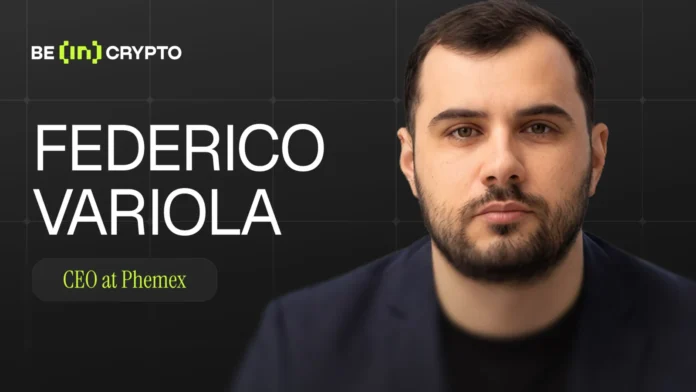
“Instead of asking how to make spending more exciting, we asked how to make the transition from market allocation to real-world execution more efficient,” said Federico Variola, CEO of Phemex.
BeInCrypto sat down with Variola to understand why the exchange stepped away from the conventional rewards playbook and what it signals about where crypto financial infrastructure is heading next.
Bridging Trading Capital and Everyday Spending
On September 14, Phemex began rolling out the Phemex Card to eligible users, plugging into a payment system accepted by more than 100 million merchants globally. Availability is being extended progressively as Phemex completes applicable regulatory and onboarding requirements in each market
Unlike most crypto cards that require users to pre-load funds into a separate card wallet, the Phemex Card settles transactions directly from the user’s spot account, converting supported stablecoins at the moment of payment in real time. Capital stays inside the trading environment until the exact moment it is spent.
But the more interesting question is why Phemex built it the way it did.
Despite a decade of crypto infrastructure development across custody, liquidity, and execution, one gap has persisted. The bridge between digital portfolios and real-world spending remained dependent on the same cumbersome sequence: convert to fiat, withdraw through a bank, wait for settlement, then spend.
The card is designed to close what Phemex calls the last mile of the trading ecosystem. Variola traces that decision directly to how the exchange’s users actually operate.
The company observed that most of them are traders or capital allocators whose primary concern is not lifestyle perks but how capital moves between active positions, stable assets, and eventually real-world spending.
“When you observe that workflow, the traditional perk card model starts to look slightly misaligned. Rewards programs tend to encourage consumption, while traders are usually thinking about capital discipline. They want to separate trading margin from spending capital and maintain control over both,” Variola told BeInCrypto.
Turning Cashback Into Trading Liquidity
That same logic extends to how Phemex has designed the card’s cashback structure. Rather than crediting rewards as fiat discounts or platform points, Phemex returns cashback in USDT directly to the user’s spot account. From there, it sits alongside trading capital and can be redeployed into positions, used for hedging, or simply held as liquidity.
The program is intentionally structured around what Phemex describes as unlimited cashback, meaning there is no maximum cap on the cashback amount a user can earn. Standard users receive 0.25% and VIP users up to 1%, on eligible transactions and subject to the Phemex Card Cashback Program Terms.
In practical terms, this means high-volume spending is not artificially capped: a user spending $10 million in a single month would see cashback calculated on the full eligible amount, reinforcing the card’s design around continuous liquidity generation rather than capped reward incentives.
It is a small but deliberate design choice that reflects how Phemex thinks about the relationship between spending and capital management. Variola sees it less as a reward and more as a recurring inflow. The Unlimited Cashback amount is designed to allow cashback to scale with eligible spending, rather than being defined by a fixed cashback-amount ceiling.
“It’s not designed to change how people spend. The idea is that if a Phemex user is already spending money in the real world, that activity can quietly add liquidity back into their trading environment over time,” he explained.
Why Europe is a Priority Market for the Phemex Card
Europe continues to develop a more defined regulatory environment around digital assets, with the introduction of the Markets in Crypto-Assets (MiCA) regulation forming part of a broader shift toward clearer rules for the sector — a trend Phemex sees as central to where it prioritizes expansion.
For users, greater regulatory clarity can help create more predictable conditions around how digital assets and related services develop over time.
“Users want to know that the financial products and infrastructure they rely on are built for the long term,” Variola said. “Europe is an important market for us because users are already highly comfortable with digital payments and cross-border spending.”
As Phemex continues to strengthen its compliance infrastructure, the Phemex Card will progressively expand into new markets. Availability of the card is subject to applicable local requirements, eligibility criteria and product terms.
Two Paths for Crypto Cards May Coexist
Phemex’s card launch comes as crypto card activity gains traction more broadly. Data tracked by Dune Analytics shows net spend across six Visa-partnered crypto cards rising 525% in 2025, from $14.6 million in January to $91.3 million in December. Much of that activity has come from DeFi-native, non-custodial models that allow users to spend against yield-bearing collateral without selling assets or leaving self-custody.
While the Phemex Card takes a CEX-integrated approach, Variola said the two models address different priorities and are likely to coexist.
In his view, the distinction is architectural. DeFi cards optimize for sovereignty, while exchange-integrated cards optimize for execution efficiency and liquidity access.
“When a card is integrated directly with the exchange environment, it can take advantage of that liquidity and execution layer. Conversions can happen instantly, settlement is predictable, and the user doesn’t have to move funds between multiple environments before spending,” he said.
Variola also pointed to compliance as a structural advantage for CEX-integrated cards. Payment networks operate under strict regulatory standards, and platforms built to work within those frameworks may be better positioned to connect crypto balances with traditional payment rails more cleanly.