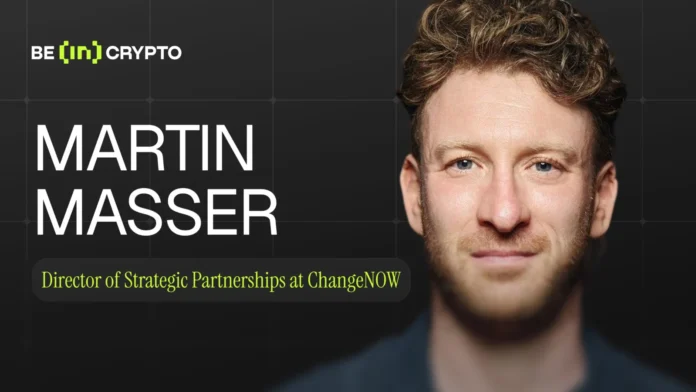
Martin Masser opens his banking app even when he has nothing to pay. Sometimes, he just wants to check his balance.
“I check my banking app all the time,” ChangeNOW’s director of strategic partnerships said during an interview at TOKEN2049 in Singapore.
Crypto platforms want a similar place in their customers’ lives. The “super app” model puts trading alongside services such as payments and borrowing, giving people reasons to return between transactions. Whether those services become a habit is a harder question.
What Brings You Back When You Have Nothing to Trade?
Asked whether crypto has enough demand for super apps, Masser started with the limits of swapping tokens. Some traders transact constantly. Others might make a swap every few days, or once a week.
He described checking earnings and reviewing previous transactions as reasons to open an app without making another trade. His comparison was with banking, where customers routinely look at their money without moving it.
“The more use cases that you get, the more you start using,” he said.
Kaiko’s 2026 research describes exchanges expanding into broader financial platforms, connecting trading balances to yield products and spending services. Keeping those activities together gives platforms more opportunities to retain customers and their funds.
Masser offered examples of that behavior, though the interview included no retention figures showing how widely it has taken hold at ChangeNOW.
Does Everyone Need the Same Reason to Return?
A super app can provide all sorts of financial resources and activities. But does it need one dominant, recurring use-case? Masser argued that different customers could build different routines around the same product.
“People use the apps in very different ways,” he said. Drawing on his earlier work in banking product development, he added: “We aren’t the user.”
A customer checking a balance may have little interest in borrowing. An active trader may care more about swap fees. Masser also pointed to AML wallet checks for money-laundering exposure among ChangeNOW Pro’s features.
His argument leaves room for occasional users. An app can become useful across someone’s financial life without demanding the attention of a messaging service.
Why Does Moving Money Still Take Several Apps?
For some users, the appeal is more immediate. They receive USDT on one blockchain and need it on another.
Masser described that as a recurring problem in conversations with customers. A transaction that looks simple to the recipient can require unfamiliar steps between networks.
He recalled his own experience of buying crypto on one platform, then moving elsewhere to swap it. Bringing those steps together could also help customers discover services as their needs develop.
“It’s much easier to have it in one place,” he said.
This is the practical case for a broader app: fewer separate processes to complete one financial task. Adding more services helps only if moving between them becomes easier.
When Does a Super App Become a Cluttered App?
That creates a design problem. The host asked how platforms could keep adding functions without overwhelming the interface.
“There’s no point adding something that doesn’t make sense for the product,” Masser said.
He used ordering McDonald’s through a crypto app as an example of a feature that could feel out of place. His test was whether services fit together and allow people to move naturally from one task to the next.
The argument puts a limit on expansion. Every additional function asks users to understand another choice. A platform promising convenience can make itself harder to navigate.
Telegram’s Audience Did Not Automatically Become Customers
Masser had seen another assumption fail during his time at TON Foundation: access to a large audience would make a product successful.
He recalled teams launching applications inside Telegram and expecting its enormous reach to deliver users. In his telling, they later returned with a complaint: “Martin, we’ve got no users.”
His response was straightforward: “Have you done any marketing?”
Masser said successful teams had considered what people wanted and worked to reach them. That experience informs the questions he now asks developers about why they are building a product and how they define success.
“Just because you think you have a big audience does not mean you’re going to have a naturally successful product.”
What Happens After the Partnership Announcement?
The same test applies to partnerships, Masser’s remit at ChangeNOW.
“You don’t want to have a partnership just to have your name on a press release,” he said.
He described ongoing work to understand a partner’s customers and help a product find its market. A business might initially integrate swaps, then add payment services later.
ChangeNOW’s API lets developers connect its services to their own applications. Masser said this could save teams from building those functions themselves and maintaining support for new blockchains.
“Maybe what you’re starting out with isn’t the finished product,” he said. His view of a partnership leaves room for that product to change after launch.
Will People Eventually Stop Calling It Crypto?
Stablecoins give this ambition a practical test. Recent reports estimate at least $401 billion in stablecoin payments during the first eight months of 2026, up 42% year over year.
Businesses received an estimated 58% to 64% of payment volume, so those figures do not establish widespread consumer spending.
Masser pointed to markets where stablecoins are already used more routinely in everyday financial activity as a reason to build services beyond holding or exchanging tokens.
Asked what would show that crypto super apps had succeeded in five years, he answered: “That you are using it in day-to-day life without realizing it’s a crypto super app.”
For the platforms building them, that means earning a place in ordinary financial routines. The user needs a reason to open the app even when there is no trade to make.