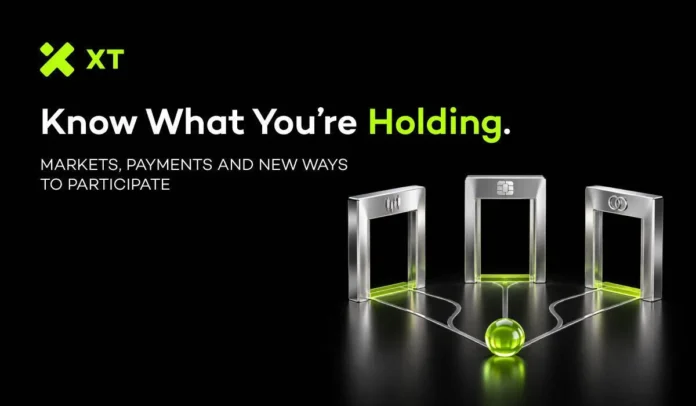
One XT Exchange balance now reaches crypto markets, equity price exposure, everyday payments, and event outcomes, and each destination is described for what it is.
Consider a single USDT balance sitting in an XT Exchange account. With it, a user might buy bitcoin. They might take leveraged exposure to the share price of a US-listed manufacturer. They might hold a token that tracks the Nasdaq-100. They might scan a QR code to pay for lunch. They might buy a Yes share on whether a named event will occur by a stated date.
Five actions, one balance. Underneath, five different financial systems, each with its own settlement logic, its own counterparties and its own definition of what the user ends up holding. That is what it now means to describe an exchange as a gateway. The word is usually read as a claim about breadth. It is more accurately a claim about connection, and a gateway is at its best when the traveler knows exactly where each door leads.
The expansion is real and recent enough to date precisely. In January 2026, XT Exchange listed a set of tokenized equity products on its spot market, including tokens tracking Philip Morris, UnitedHealth, a Vanguard fund and the Nasdaq-100. In July 2026, it listed eight USDT-margined perpetual futures referencing US-listed companies and funds, among them Caterpillar, Texas Instruments and Take-Two Interactive, with leverage available up to 25x. In May 2026, it opened an event-market venue whose markets resolve against an external source. Alongside these sit spot and margin trading, and XT Pay, which lets eligible users in supported markets pay participating merchants from a USDT balance while a third-party provider settles with the merchant in local currency.
Set out as a list, that reads like a catalog. Read structurally, it is something more interesting: an account that now touches at least four distinct settlement worlds. A spot trade settles on the exchange’s own books. A perpetual future settles in USDT against a reference price, with funding and liquidation rules attached. A prediction market resolves against an external source and an agreed outcome. A payment settles in local currency, through a payment company, into a merchant’s ordinary bank arrangements. None of those processes is a version of the others.
The most important distinction runs between the two traditional-market products, because they are the ones most likely to be read as equivalents. A tokenized equity product and an equity-referencing perpetual future can show the same company name on the same screen. They are not the same instrument. XT describes its tokenized stock products as fully collateralized, freely transferable instruments that track the price of publicly traded shares: tracking, not a shareholding. The perpetual contracts are described explicitly as leveraged derivative contracts rather than direct equity ownership. Neither delivers the rights that come with owning shares, and neither claims to.
A user who wants exposure to a company’s price is served by either. A user who wants to own part of a company is served by neither. The screen cannot make that distinction on its own; the product description does, and XT’s descriptions are written to do exactly that.
“Every product we add gets described for exactly what it is,” said Arman Achmed, COO of XT Exchange. “If a user can’t say in one sentence what they’re holding and what moves its value, we haven’t finished building it.”
The same applies to event markets. A price on an event is an aggregated expectation that moves as participants trade, not a measurement of what will happen. And the outcome is decided by a resolution process outside the exchange, a feature of the product’s structure that XT states up front.
This is where the gateway framing earns its keep. XT’s approach has been to let the product descriptions carry the distinctions: tokenized stocks track a price, perpetuals are leveraged derivative contracts, event markets resolve against an external source, payments are settled by a provider in local currency. Each label names a different relationship between the user and the thing on the screen, and each is stated before the trade rather than after it.
That precision is what makes breadth worth having. More instruments mean more ways to express a view, and the user who can say what they bought, what determines its value, who settles it and what happens if the thing they are tracking moves against them is the user who can use all of them well. An account that reaches four settlement worlds and explains each one is a wider financial world in the practical sense: more of a person’s financial life can be run from one place, with the structure of each part visible.
A wider financial world is genuinely on offer. It arrives one door at a time, and each door opens onto a different building. XT Exchange’s answer has been to label the doors.
About XT Exchange
Founded in 2018, XT Exchange is a global digital asset trading platform serving more than 12 million registered users across over 200 countries and regions. Its services span spot, margin and futures trading, TradFi market exposure, a real-world asset marketplace, and everyday payments through XT Pay. Guided by Xplore Crypto Trade with Trust, XT Exchange enters its ninth year with Build the NeXT, reflecting its focus on trust, broader market access, and practical uses for digital assets.