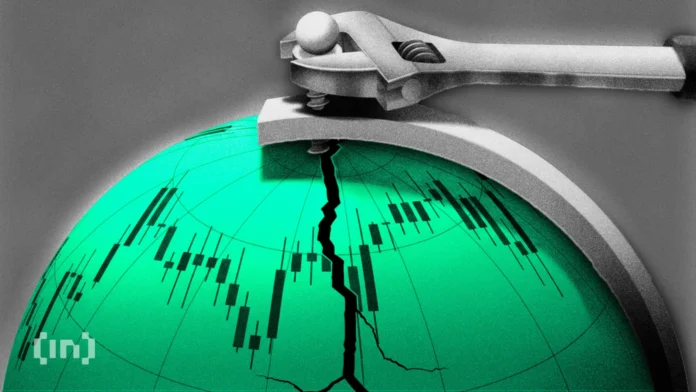
The world economy is entering a dangerous period, but a Great Depression-style collapse is still a remote possibility.
A prolonged economic slowdown, further stock-market corrections, and a potential recession in some major economies are much more credible risks.
What’s more concerning is a combination of problems developing simultaneously.
- Wall Street is questioning whether the enormous investments in AI will generate sufficient profits.
- China’s domestic economy remains weak.
- The war in the Middle East has pushed oil prices above $117 a barrel.
- Inflation is proving stubborn, and governments have less financial flexibility to rescue their economies.
Individually, these problems are manageable. Together, they increase the possibility of a more serious downturn.
What the Latest Economic Data Tells Us
There’s an important distinction between a financial-market crash and an economic crisis. Stocks can fall 30% without producing a global depression.
The situation becomes much more dangerous when declining asset prices trigger defaults, reduce lending, and cause businesses to cut investment and jobs.
We have evidence of the first stage, but it’s much weaker for a worldwide economic breakdown.
However, these forecasts rely on assumptions about energy supplies, financial conditions, and investment that could deteriorate. The IMF’s projections were based on information available through October 1, before the latest market turmoil.
The biggest concern is that the global economy has become unusually dependent on a few sources of growth while its traditional economic safety mechanisms are under pressure.
AI Economy is the Biggest Risk of 2027
AI spending has become a significant contributor to investment growth in the United States. It has also supported exports from Asian chipmakers and generated orders for companies building data centers.
A serious reduction in AI spending would affect a much wider set of industries than technology shares.
The problem is the interconnected financing.
An AI company may receive money from a technology investor and then commit to buying computing services from that investor. Those promised future purchases help justify further infrastructure spending and borrowing.
If the AI company’s revenue disappoints, multiple businesses can suffer simultaneously. The investor’s stake loses value, future service revenue becomes uncertain, and creditors become concerned about repayment.
The IMF explicitly identifies this interconnected financing as a potential channel for wider financial stress.

The most frightening economic scenario is a sequence of AI infrastructure bankruptcies followed by widespread cancellations of data-center projects. That would indicate that the decline had moved beyond stock valuations.
So far, evidence of that industry-wide collapse is lacking.
Oil and Inflation are at the Heart of All Financial Nightmare
The second major risk is the Middle East conflict.
Brent crude reached approximately $116–117 on October 23, while the US 10-year Treasury yield was around 5%.
These two figures create an uncomfortable situation for central banks.
Consider what happens if businesses begin losing customers and unemployment rises.
Ordinarily, a central bank could respond by reducing interest rates. Cheaper financing would help households and businesses.
But if oil prices remain high, inflation may remain elevated. Cutting interest rates aggressively could then intensify inflationary pressures.
In its October forecast, the IMF estimated that a prolonged Middle East conflict keeping oil above $130 through the first quarter of 2027 could reduce next year’s global growth rate by around 0.5 percentage points.
Can China Trigger a Worldwide Recession?
China’s economic problems are important because it is one of the world’s largest manufacturing economies and a major consumer of raw materials.
Its property crisis has reduced household confidence. Weak spending is holding back business revenue, and companies have been cutting prices to compete for customers.
There are two possible international spillovers.
First, a slowdown in Chinese imports. If China’s construction and manufacturing sectors reduce their purchases, commodity producers and exporters elsewhere may suffer.
Second, more intense export competition. Chinese manufacturers facing weak domestic demand may seek more customers overseas.
Cheaper goods could help contain inflation in importing countries, while putting pressure on competing manufacturers and increasing trade tensions.
China’s situation is a persistent drag on world growth. A more dangerous scenario would involve disorderly failures at major financial institutions or a sudden deterioration in credit availability.
China still has substantial state control over its banking system and capacity to intervene, which can reduce immediate financial contagion.
That does not eliminate the cost of prolonged economic weakness.
We Might Not See Another Great Depression, Yet
There are several important signs that the financial system is still functioning.
- US unemployment remains relatively low. The September unemployment rate was 4.2%. Hiring is weak, with just 29,000 jobs added, but we have not yet seen the widespread layoffs characteristic of a major economic crisis.
- New unemployment claims remain contained. Weekly initial claims fell to 194,000 in the latest report, the lowest level in three months.
- Broad corporate credit markets are functioning. US high-yield corporate credit spreads were around 3.27 percentage points on October 21. By comparison, they reached almost 20 points during the 2008 credit crisis. Today’s figure does not indicate a comparable system-wide credit freeze.
The IMF also describes the global banking system as broadly resilient, although it warns of vulnerabilities in private credit and highly leveraged investment strategies.
The important comparison is therefore closer to the early-2000s technology correction, with additional energy and sovereign-debt risks.
A 2008-style crisis would become more plausible if the losses spread through credit markets, major lenders became distressed and access to financing deteriorated sharply.
A 1930s-style depression would require an even more severe and prolonged breakdown in economic activity.
Neither is established by the market evidence available today.
4 Possible Outcomes for 2027
A broader analysis can divide the next 12–18 months into four scenarios.
These probability estimates are my subjective assessment of the current evidence. They are not outputs from a calibrated forecasting model.
Most Likely: Painful Market Correction, Continued Economic Growth
Technology stocks experience further repricing. AI investment growth slows, oil eventually stabilizes and the world economy continues expanding unevenly.
Stock markets remain volatile, although diversified investors may see recoveries before economic data noticeably improves.
Material Downside Risk: Stagflation and Regional Recessions
High energy prices persist. Consumer spending weakens and businesses reduce investment. One or more major economies enter recession, while global growth remains weak but positive.
Equities could enter a prolonged bear market, and central banks have limited flexibility to stimulate growth.
Severe Downside: Synchronized Global Recession and Financial Stress
AI investment declines sharply, defaults spread through vulnerable borrowers and financial institutions restrict lending. Higher unemployment and falling demand reinforce each other across major economies.
This would resemble aspects of 2008, with substantial losses across risky assets.
What Does This Mean for Crypto Markets?
Crypto investors should pay particular attention because their portfolios can be highly exposed to changes in global liquidity.
Bitcoin was trading around $82,000 on October 23. US spot Bitcoin ETFs experienced approximately $636 million in net outflows on October 22, following three days of strong inflows.
Institutional digital-asset platform Talos estimated Bitcoin’s 30-day correlation with the Nasdaq at around 0.6 on October 22. That indicates meaningful positive co-movement recently, though the relationship changes over time.
| Market environment | Likely implications |
| AI-led stock correction | Bitcoin may remain volatile, with losses concentrated in speculative altcoins |
| Inflation and high rates persist | Borrowing stays expensive; liquidity-sensitive crypto assets face pressure |
| Recession and forced deleveraging | Bitcoin and altcoins could fall sharply as investors raise cash |
| Inflation falls and liquidity improves | Conditions may become more supportive for crypto recovery |
The important point is that Bitcoin cannot be assumed to protect a portfolio during an immediate financial panic.
An asset can have a long-term scarcity thesis and still fall sharply when investors urgently need liquidity.
Traders should be particularly cautious about altcoins going into 2027. Many have weaker liquidity and depend heavily on speculative demand. Some may not recover even if Bitcoin eventually reaches new highs.
There is a possible positive development for crypto further ahead. If inflation falls enough for central banks to ease monetary policy while financial stability is preserved, Bitcoin could benefit from improved liquidity.
But aggressive rate cuts during a financial crisis would not necessarily produce an immediate crypto rally. Forced selling often comes first.

5 Warning Signs to Monitor in 2027
| Indicator | What would make me more concerned |
| AI company earnings | Major firms begin cutting data-center spending because expected returns are disappointing |
| Oil prices | Brent remains above $120–130 for an extended period |
| US unemployment | A sustained rise from 4.2% toward 5% or higher |
| Corporate credit spreads | US high-yield spreads widen substantially, especially beyond 5–6 percentage points |
| Banking and private credit | Defaults accelerate and lenders significantly reduce access to financing |
These are monitoring thresholds, not precise recession triggers.
If oil prices decline, credit markets remain stable and corporate earnings hold up, the global outlook could improve substantially.