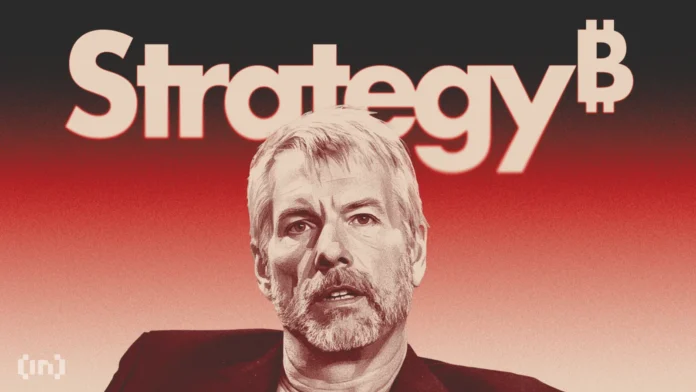
Michael Saylor is advocating for US financial institutions to securely hold Bitcoin (BTC) for clients and provide loans backed by the asset, projecting that the digital asset market could eventually expand into a $100 trillion sector.
As the chairman of Strategy (formerly MicroStrategy)—a software firm widely recognized for its massive Bitcoin acquisitions—Saylor outlined this blueprint in a policy publication following his appearance at the Bitcoin Policy Institute’s Freedom Tech DC summit.
What Saylor Wants Banks to Do With Bitcoin
Saylor envisions banks providing custody services, which involves safeguarding Bitcoin on behalf of users. He also calls on them to facilitate loans secured by that cryptocurrency, provided there are transparent and practical regulations in place.
He contends that current international capital guidelines create significant obstacles. Specifically, the Basel framework establishes global benchmarks dictating how much financial backing banks must maintain for their assets, assigning its highest-risk crypto category a punitive 1,250% risk weight.
Highlighting that number as proof of overly harsh regulatory measures, Saylor suggests that authorities should distinctively separate three separate functions:
- Safeguarding Bitcoin on behalf of a client
- Extending loans backed by the asset, and
- Investing a bank’s proprietary funds.
He anticipates that broader involvement from the banking sector will act as a primary catalyst for expansion. According to his perspective, increased competition among banks vying for Bitcoin holders will draw new funds into an asset constrained by a fixed supply.
MicroStrategy tracks institutional adoption through its Bitcoin Banking Adoption Index, which estimated that major banks had achieved a 32% uptake rate as of July.
Even so, major financial institutions remain divided on the matter. JPMorgan CEO Jamie Dimon has publicly criticized Bitcoin by calling it a “pet rock,” though Strategy CEO Phong Le asserts that Dimon supports it behind closed doors.
“The age of Digital Assets and Digital Intelligence needs a bill of digital rights, not a bill of restrictions,” he explained.
Where Saylor’s $100 Trillion Figure Comes From
Saylor links this ambitious valuation to the rise of artificial intelligence (AI). He anticipates that autonomous AI agents—software designed to act independently on behalf of individuals—will handle tasks such as research, negotiation, and purchasing.
Such an economy requires a medium of exchange capable of operating at the speed of software on a 24/7 basis, he notes. Conversely, the legacy financial infrastructure depends heavily on human verification and traditional working hours.
Saylor asserts that Bitcoin and alternative digital assets are ideally suited for this environment, estimating the total market potential at $100 trillion, though he has not specified a timeframe for achieving this milestone.
Why Saylor Is Turning to Regulators, Not Congress
This strategy pivot follows a legislative setback. On September 15, the US Senate narrowly defeated the CLARITY Act in a 49-50 vote, rejecting a measure that aimed to establish regulatory frameworks for domestic cryptocurrency markets.
Describing the defeated legislation as overly reliant on limitations, Saylor now believes that the most viable strategy for the next two years involves engaging directly with the SEC, the Commodity Futures Trading Commission (CFTC), the Treasury Department, and the White House.
Under his proposed framework, the Treasury and banking watchdogs would formulate feasible guidelines for Bitcoin custody and credit markets, while lawmakers simultaneously scramble to craft alternative legislation to replace the CLARITY Act.
Frequently Asked Questions
What are Michael Saylor’s main proposals for US banks regarding Bitcoin?
Saylor wants US banks to offer custody services for customer Bitcoin and issue loans backed by that Bitcoin under clear, workable rules. He also urges regulators to separate three distinct banking activities: holding client Bitcoin, lending against it, and taking positions using the bank’s own money.
What is the source of the $100 trillion digital asset industry projection?
Saylor ties the $100 trillion figure to artificial intelligence and autonomous AI agents that will need software-speed money to research, negotiate, and buy things 24/7. He believes Bitcoin and digital assets fit this digital economy, though he has not provided a timeline for reaching that valuation.
Why is Saylor turning to financial regulators instead of Congress?
After the Senate voted 49-50 against advancing the CLARITY Act on September 15, Saylor concluded that the bill relied too heavily on restrictions. He now views regulatory agencies like the SEC, CFTC, Treasury, and the White House as the best path forward over the next two years.