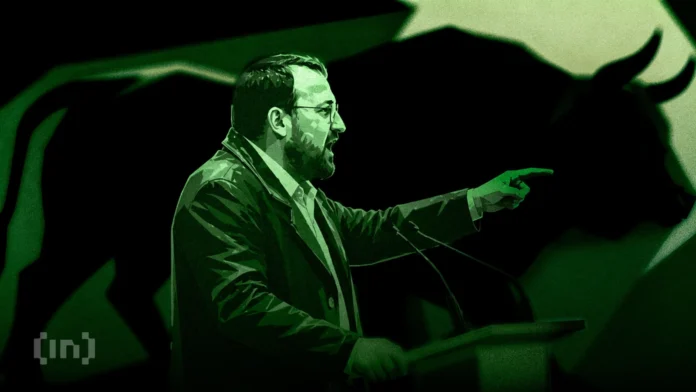
Cardano founder Charles Hoskinson told a United Nations audience he does not trust the European Union with a digital euro. He predicted it would enable “asset and transaction discrimination” within a decade.
On paper, the EU’s draft law already rules out programmable spending rules. However, that text is still under negotiation, and Hoskinson argues only a binding law would prove his fears wrong.
Why Hoskinson Wants Digital Euro Limits Written Into Law
Hoskinson spoke on October 2 at the Future of Money, Governance & the Law Summit in New York. The Government Blockchain Association (GBA) hosted it at UN headquarters.
He warned that a central bank digital currency (CBDC) risks becoming a “financial panopticon” that watches and blocks payments.
“You’re going to go to buy some fuel and even though you have €2,000 in your bank account, it’s going to decline your card and say, ‘Well, I’m sorry. You’ve already purchased 50 L of petrol this month. You’re not allowed to buy anymore.’ Don’t believe it? Well, then put it in some sort of law that you’re not going to do it.”
He pitched his Midnight privacy network as an alternative. Code, he said, shifts the standard to “can’t be evil.”
The same day, BeInCrypto Global Head of News Brian McGleenon led a summit panel on AI outpacing financial regulation. Experts from the Internal Revenue Service (IRS), Mastercard, and the UN Joint Staff Pension Fund debated who controls money-moving AI agents.
The session also launched joint BeInCrypto Research and GBA research on AI, blockchain, and quantum computing in finance. Final findings are due in January 2027.
Does the Draft Law Already Answer Him?
The European Parliament voted 416 to 169 on July 9 to open trilogue talks, closed-door negotiations with member states and the Commission.
The third round on September 30 ended with no deal on merchant fees or holding limits, which cap individual balances.
Meanwhile, the Commission’s 2023 proposal states that the digital euro should not be programmable money. Then-European Central Bank (ECB) board member Fabio Panetta also told lawmakers in 2023 the bank would never limit where, when, or to whom people pay.
None of these safeguards is binding yet. The ECB plans a 12-month pilot from late 2027, with possible issuance in 2029.
In contrast, the US Senate has passed a temporary CBDC ban running through 2030. Europe’s negotiators must now show that written guarantees can satisfy critics who trust only code.