Everywhere you look, financial media and conference panels are preaching the same gospel: autonomous AI agents are about to take over finance and spend serious capital on our behalf.
A new BeInCrypto Intelligence report, published in collaboration with AWS, Cloudflare, Chainalysis and Zoomex, finds a striking gap between the promise of autonomous finance and what machines actually do with money.
The State of AI Agent Payments 2026 tracks actual payments and AI financial tools. Its findings challenge the hype:
- 90.8% of sampled x402 payments were below one cent. Across a 35-day study of 6.4 million transactions, just $119,947 changed hands. Much of the activity involved API access, computing resources, and automated data requests.
- Institutional readiness is far behind micropayments. On the report’s 100-point assessment, micropayments scored 60.7. Institutional financial workflows managed just 12.0.
- Humans still control most financial decisions. Fourteen of 19 reviewed AI tools operated within preset spending or trading limits. AI-labeled interfaces represented less than 0.55% of Hyperliquid’s trading volume, while Zoomex order-preparation workflows required human confirmation.
Six of 12 institutional workflows could initiate or settle payments within authorized limits. Whether businesses will trust agents with meaningful sums remains uncertain.
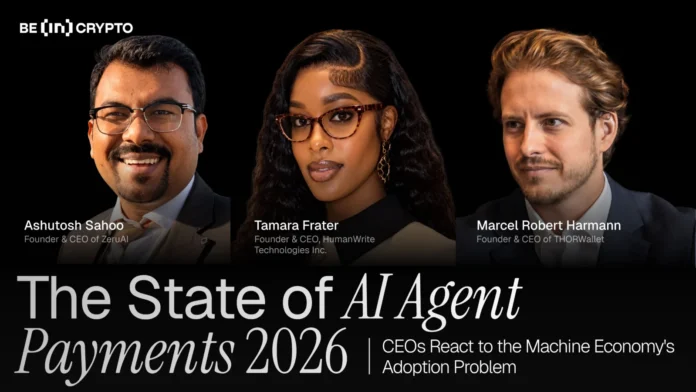
BeInCrypto asked three industry leaders what stands between micropayments and serious capital.
Bigger Payments Need Safer Custody
Marcel Robert Harmann, founder and CEO of THORWallet, expects more agentic trading in the next 12 months. Venues such as Hyperliquid already offer APIs for automated execution. The challenge is controlling the funds.
“Microtransactions, where agents pay for data or compute, will continue to dominate the transaction count. Volume will likely increase as more actual trading runs through agents.”
Harmann sees threshold signatures as one way to reduce the danger of giving an AI agent unrestricted access to a wallet. Instead of relying on a single key, a payment can require authorization from separate participants, including a signer that checks whether it complies with policy.
“With threshold signatures, the agent can hold one key share and an independent policy signer can hold a second one. We can adapt our workflows to the new situation.”
That could let agents initiate higher-value transfers without giving them the ability to move funds entirely on their own.
Harmann also expects regulators to adopt automated monitoring as transaction counts rise. Humans cannot examine every machine payment individually, he argues. Oversight systems will need to identify suspicious activity at the same pace, with people retaining final authority.
The Financial System Itself May Need Rebuilding
ZeruAI founder and CEO Ashutosh Sahoo believes the obstacles run deeper than custody.
“I don’t expect a meaningful shift beyond micropayments until we begin building an AI-native financial system. Existing banking infrastructure, compliance frameworks and liability models were designed around humans and institutions, not autonomous economic actors.”
Today’s agents typically work within fixed spending limits, trading mandates and emergency stop mechanisms. Sahoo views these setups as supervised automation rather than financial independence.
“The real inflection point comes when we stop fitting agents into human financial infrastructure and start designing financial systems around their capabilities.”
His idea would change how compliance works. Instead of checking payments mainly after they happen, systems could enforce spending permissions and risk rules directly through their protocols.
“If code is law, much of financial regulation could become enforceable at the protocol level rather than through retrospective surveillance.”
That raises difficult questions about who writes those rules and who can change them. Sahoo also worries that machine-designed financial systems may eventually become too complex for people to understand, even when their decisions follow a coherent logic.
An Agent Can Follow Every Rule and Still Lose Money
HumanWrite Technologies founder and CEO Tamara Frater expects uneven growth. Buying computing power is simple; investment decisions carry much higher stakes.
“The next 12 months may bring more experimentation, but I don’t think the market jumps straight from sub-dollar payments to broad autonomous financial decision-making.”
Frater is particularly concerned about mistakes that happen inside an agent’s existing permissions. A system could respect its spending cap while acting on misleading instructions or sending money to the wrong recipient.
“The biggest concern is an agent making the wrong decision while still operating within its authorized permissions. Spending limits reduce exposure, but they do not guarantee that the recipient, instruction or underlying information is correct.”
The report documents two incidents in which a combined $281,200 was sent to attacker-controlled wallets before recoveries. Those cases show why limiting how much a machine can spend does not settle the question of whom it should trust.
Frater expects financial institutions and regulators to use AI to identify suspicious activity as automated transactions multiply. But she wants decisions to remain traceable to responsible people.
“The challenge will be making oversight faster without making responsibility harder to trace.”
The Next Test is Real Capital
The three executives differ on how AI payments might mature. Harmann focuses on wallet security. Sahoo wants financial systems designed around autonomous agents. Frater emphasizes the risk of authorized but mistaken transactions.
What connects their views is the gap between processing a payment and being trusted to make a financial decision.
For investors, transaction counts are a weak measure of adoption. The better test is sustained commercial payment value and whether businesses trust agents with less human intervention.
For now, the first wave of agentic payments proves that machines can pay pennies on-chain. The next phase has to show whether firms will let them handle serious money.