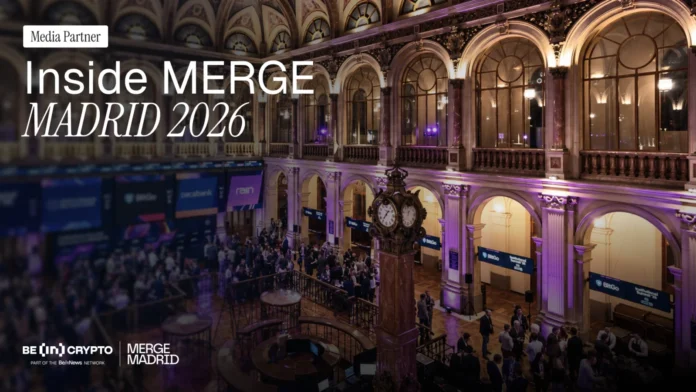
MERGE Madrid ran from October 27 to 29, opening at Bolsa de Madrid, the city’s stock exchange, before the main program moved to Palacio de Cibeles. Luís De Magalhães, our Head of Latin America, and Martin Coxall, our VP of Institutional Partnerships, represented BeInCrypto.
Key Themes From MERGE Madrid
Much of the program focused on banks moving beyond crypto trading to build the infrastructure behind stablecoins and tokenized assets.
Stablecoins Turn Into Payment Rails
Jordan Wain, Global Policy Lead at Chainalysis, said cryptocurrency economic activity reached about $9.4 trillion between June 2025 and June 2026, down 1.6% year on year despite weaker markets. Over the same period, cross-border stablecoin transfers rose 80%. In his reading, digital assets are being used for real transactions even when prices fall.
Alexandra Soroko of Visa pointed to stablecoin card settlement, which lets institutions settle obligations seven days a week. She named cross-border business payments and corporate treasury as the next areas for growth.
Marie Winter, Managing Director of OSL EU, said the company is “a MiCA license entity in Austria” and received its MiCA license at the beginning of July. “We are currently also applying for a payment institution license and an EMI license,” she said, with the EU focus “on third-party payment, exchange services, on and off-ramp and related services.”
Banks Rethink Their Role
“Where are banks making money today on digital assets? This is still the crypto offering they have towards their clients,” said Stijn Vander Straeten, CEO of Crypto Finance Group, part of Deutsche Börse. Behind that, banks are investing in staking, tokenized deposits and new settlement infrastructure.
Executives from Commerzbank, N26 and Applied Blockchain described banks increasingly acting as the infrastructure that lets clients use stablecoins, instead of holding large amounts of them.
Mirko Pfiffner, Senior Solutions Manager at Liechtenstein’s Bank Frick, which has worked in crypto and blockchain for ten years, rejected the idea that the industry no longer needs banks. Exchanges, liquidity providers and other crypto companies “are very huge in fiat and they still need banking,” he said. Over the next five to ten years, he expects banks to specialize: “not just have one private bank who is overseeing all the different aspects, but probably you have just payment rails for banking, or you just have a custody bank or trading bank.”
António Henriques, CEO of Bison Bank, Portugal’s first CASP inside a licensed bank, said the bank serves customers coming directly from the crypto ecosystem as well as regular banking customers. “Bison Bank is exactly in the middle,” he said. “Both are filling some gaps, and we are indeed trying to help them in moving in this crypto area.”
“It’s not primarily a technology problem, it’s an operating model issue,” said Shrutisagar Chandrasekaran of Fireblocks. “It’s about people, process and governance.” Luis Nacarino of Santander CIB said new digital money systems must be able to talk to one another rather than operate as isolated networks. Alberto Carlos Alonso Temprado of Iberpay said Europe’s payment rails already work well and blockchain should build on them: “We don’t need to reinvent the wheel. We have to make it better.”
The final day turned to regulation and investment, with supervisors from Spain, Portugal, Italy, Greece, Croatia, Cyprus and Luxembourg. Jason Jiang, Chief Business Officer at CertiK, said: “This is our chance to get to know the institutional players from Europe.”
Tokenization and AI Agents
Bit2Me CSO Abel Peña said the company has received authorization to launch STX, a security token offering for tokenizing shares and bonds, aimed first at medium-sized companies. On the same panel, BBVA and Bullish warned that tokenization only works if investors have enough liquidity to trade, including in volatile periods.
Mastercard, Tether and the Cardano Foundation discussed AI agents paying on behalf of consumers and businesses, and why clear permissions and digital identities will be essential.
Luis Ayala, Managing Director for Latin America at BitGo, tied part of the payments shift to agentic wallets, which he described as “an artificial intelligence agent that, in the end, is an LLM, but has the ability to make a payment on behalf of a natural person.” He expects their use to spread from households to companies: “If this starts to happen at the atomic level of families, imagine how it will also affect institutions. We are going to see agents roaming through micro-production, micro-processes, micro-services at the institutional level.”
In an interview with BeInCrypto, TRM Labs’ Guillaume Rodenas said KYC for AI agents should start with verifying the person or company that controls the agent.
BeInCrypto on Stage
Our Head of Latin America hosted the Institutional Summit stage at Bolsa de Madrid, and moderated two stablecoin panels.
Western Union and Anchorage Digital: USDPT
On stage:
- Malcolm Clarke, Global Head of Digital Assets, Western Union
- Emilio Rivero Coello, Product Manager for Stablecoin Correspondent Banking, Anchorage Digital
Western Union launched the dollar-backed token on Solana in May, issued by Anchorage, starting in Bolivia and the Philippines, two remittance-heavy markets. Western Union positions it as a replacement for the rails it uses to settle with agents, not as a consumer product. For Anchorage, the aim is to replace pre-funded correspondent accounts with stablecoin balances, cutting settlement from days to minutes.
Building Europe’s Regulated Euro Stablecoin: The Qivalis Consortium in Practice
On stage:
- Vid Hribar, Institutional Partnerships, Qivalis
- Elma Saric, Stablecoin Strategic Area Lead, Raiffeisen Bank International, a founding member
- Niccolò Bardoscia, Head of Digital Asset Trading & Investments, IMI CIB, Intesa Sanpaolo
- Tania Griffith, Commercial Director, UK & Europe, Ripple
The Amsterdam-based consortium has grown from nine founding banks to 37 institutions across 15 countries. It plans to run under MiCA, supervised by the Dutch central bank, on public Ethereum. Euro stablecoins total less than $1 billion in market cap, against more than $300 billion for dollar-backed tokens.

Madrid, On Record
Malcolm Clarke, Global Head of Digital Assets, Western Union. Why the company is backing its own stablecoin, USDPT, to free up capital parked with correspondent banks, plus its crypto-to-cash service with Rain and Visa and his doubts about the hype around AI agent payments. Read the interview
Guillaume Rodenas, Sales Account Director France, TRM Labs. Who is accountable when AI agents move money, why KYC should start with the human behind the agent, and why European banks differ more in willingness than readiness for on-chain risk. Read the interview

BeInCrypto is part of the BeInNews Academy Ltd, an independent media group covering the convergence of finance and digital assets. We help professionals act with confidence in a complex and fast-changing industry through our newsroom, research reports, events, expert network and multimedia studio.